Kantha is so dense with meaning and layers and emotional subtext that a simple reading of whether it’s good or bad, impactful or not, would be a grossly reductive, unfair response to it. The longer I contemplate the film, the more it seems to reveal itself… the writing choices and the emotional motivations underneath its period murder-mystery structure. And this, along with the way the film is shot, and how fiercely the cast and crew seem to have bought into it, means I find myself feeling rather kindly towards it.
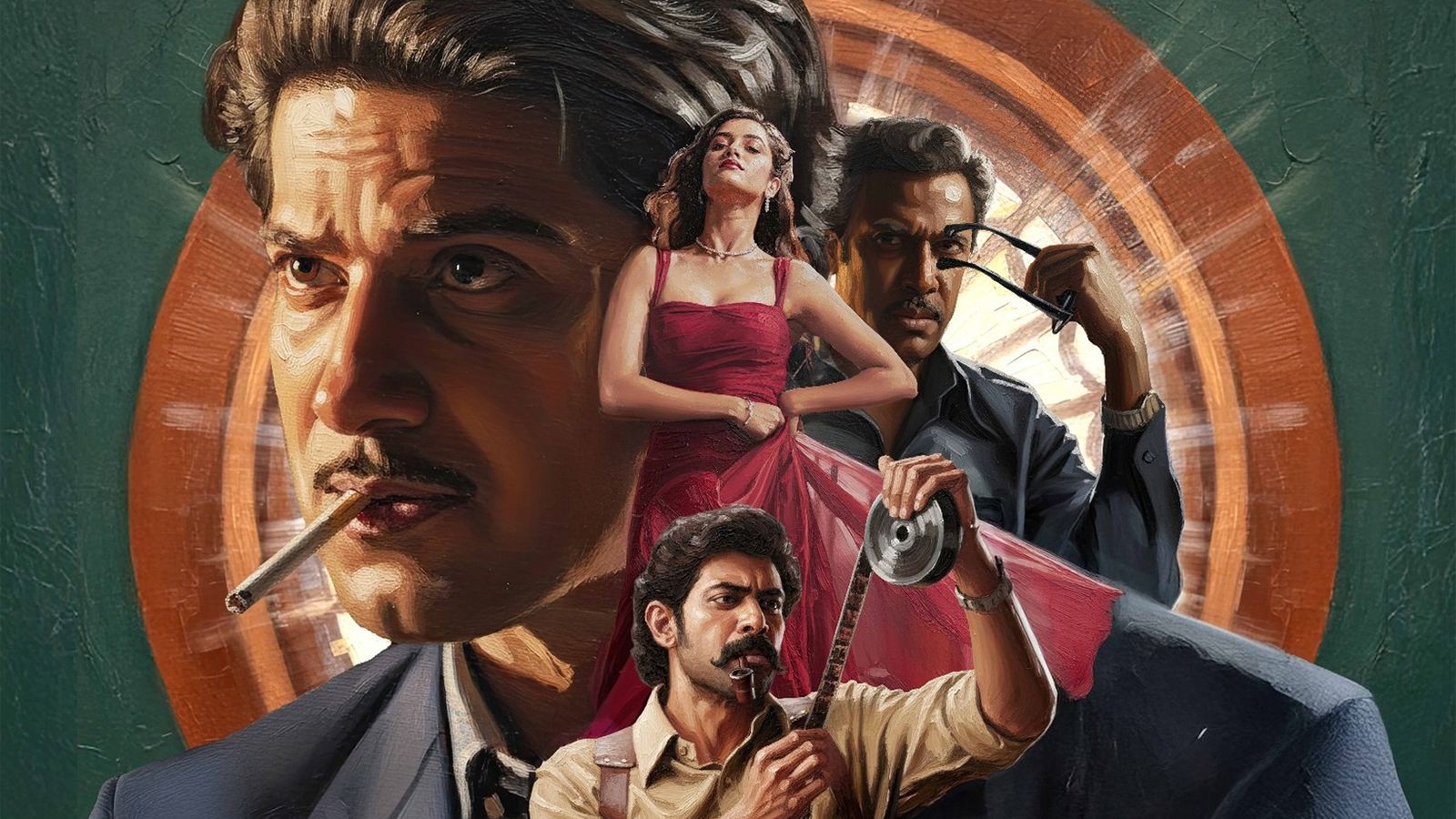
The film’s most apparent commentary is about the corruptive pull of fame and public validation… which lands harder in today’s social-media era than it might have when this film is set. TK Mahadevan (Dulquer Salmaan) is a man who seems to have steadily degraded in the face of applause, like metal to salt water. Isn’t that why he turns so red at the smallest hint of criticism? Isn’t that why he can’t bring himself to listen to the full recording at the end? His mentor Ayya (Samuthirakani) seems to read all of this as a kind of ethical decay. Watch Ayya (Samuthirakani) staring at TKM with a quiet sneer for much of this film.
Ayya, of course, is the purist, the man who wants to make cinema from a place of honesty, from personal wounds. He’s the kind of filmmaker to turn to a debutante (Bhagyashree Borse, whose face really does have a classical radiance) and call her the real protagonist of his film. But Ayya’s tragedy is his unshakeable belief in his own righteousness, his inability to see TKM as anything more than a fallen student. These are such lovely tensions… They are crafted with care, scattered across the film like clues waiting to be picked up. The more you observe and reflect, the more you pick up.
Completing this primary-characters triangle is Kumari (Bhagyashree again), the purest of them all. Why is she uncorrupted? Not just because early tragedies have humbled her, but because she stands where TKM once stood… at the cusp of a first film, in the presence of possibilities. You sense that TKM falls for her not merely because she is beautiful, but because she shows a version of himself he has lost and forgotten. I thought there was poetic irony about her fate: her death and her first film retain her in her purest form, while TKM is destined to keep living, succeeding, and rotting. Like Salieri in Amadeus maybe?
So what is the simplest summary of this film? Two vain men fighting over a woman? A clash of egos between two artists? Kaantha, for me, is about the death of innocence. About how any pursuit of public adoration inevitably taints the soul. The murder-mystery structure interprets this idea literally, even indulging in some Agatha Christie-esque pleasures. The trouble is, this isn’t built like a whodunit. Genre-blending is fine, but only when all those genres offer their pleasures. Here, the TKM–Kumari romance unfolds through a string of fairly generic beats, and the detective angle, despite a hilarious Rana Daggubati, doesn’t quite explode with excitement.
And yet, I’ll stand by Kaantha. I would hate to become to it what Ayya becomes to TKM… blind to its humanity, only because the emotional highs aren’t quite satisfying enough. Yes, it all feels cold, even mathematical, but there’s definite intent here in craft and performances, especially Dulquer who’s allowed to explore a ridiculous range here, from Chaplin-esque antics to Bergman-esque anguish. In one of his best moments in the film, he’s looking at a fallen woman and lamenting… and it’s the kind of film that gets you seeing how TKM’s finest performance comes not from technique, but from truth. The kind of truth Ayya has been seeking from him for years. Do Ayya’s claps register unforgettably? Perhaps not, but I get it.
As I said, there are pages and pages of commentary here. There is definite craft: the noir ambition, the B&W passages, that gorgeous shot of a car with headlights by a beach at night, all the mirrors, the thumping score that sometimes is a bit too much. If the characters had risen beyond their paper descriptions, if the emotions had truly come alive, we might have had something truly extraordinary here. But Kaantha is still a thoughtful film, a story of ambition and sadness and how they are often interconnected.
I’ll take it for now.
 Sudhir Srinivasan